June 11 2019

Managing Misbehaviour

Some key learnings for me.

  • A rule is only effective if it is followed through.
  • Consequences need to be consistent and you need to support one another
  • Using methods such as quiet time and time-out to deal with misbehaviour are more appropriate and effective rather than spanking.
  • The idea with consequences is for the child to follow instruction and not to use these methods as forms of threat.

Below is my action plan

Over the weekend, we will discuss the four ground rules as per below.

1. We ask calmly.
2. We walk inside the house.
3. We do not interrupt conversation but we say excuse me.
4. We say our feelings and we ask for help.

Choose one or two strategies you particularly want to try out with your child and set a clear goal about using them.

  • directed discussion
  • clear, calm instructions

Make a time to talk to your child about your new strategies before you use them. If possible, start using your new strategies on a day when you are likely to be at home and when you don’t have any time pressures or other things you need to do.

Start using your reward chart.

This is a good time to start using your reward chart now that you have some consequences in mind if you have to manage any problem behavior. Remember, don’t criticise or take away stars if your child doesn’t reach the goal, but make sure you follow up with consistent consequences for misbehavior.

Remember to keep track of your child’s behavior.

Behaviors to monitor:

  • How many times my kids come when I call them for the first time.
  • How many times I praise them for positive behavior.

Don’t forget about your own needs or looking after your relationship. What do you plan to do for yourself in the next week? 

I need to recognise when I am off track and proactively put myself back to track by giving my self a breathing space.

I also need to checked-in with my partner how she is going and if our family is on track.
Category: PostIt | LEAVE A COMMENT
May 28 2019

Talk to your kids during dinner

I do believe that family should spend time together during mealtime as this is the time to nourish the body with food and also spend time to have a mindful conversation.

The New York Times has a great article on How to Have Better Family Meals which is a good start if you are struggling to kick-off this habit. Below is a section of the article which is a list of conversation starters so you can start engaging with your kids during dinner.

Harvard’s Family Dinner Project offers these conversation starters for every age to keep the table talk fun and interesting.

Ages 2-7

  • If you joined the circus, what would your circus act be?
  • If you were a teacher and could teach your students anything at all, what would you teach them?
  • If you were free to do anything you wanted all day, what would you do?
  • In the book “Green Eggs and Ham,” Sam-I-am refuses to try green eggs and ham. Then he does and he likes them. Has something similar ever happened to you?
  • If you had superpowers, what would they be, and how would you use them to help people?

Ages 8-13

  • Question game. Which do you like more: Dogs or cats? Sneakers or sandals? Chocolate or vanilla? Earth or space? Summer or winter? Zoo or aquarium? Beach or mountains?
  • What was your favorite book or movie from last year? What did you like about it?
  • If you were principal of your school, would you change anything? What?
  • If you could change one thing about your family or about school, what would it be?
  • Create a brand new holiday along with new traditions for the world. Describe the what, when, why and how.

Ages 14-100

  • What is your most unusual talent? Demonstrate it!
  • 20 questions. One family member (the leader of the round) thinks of a person known by everyone at the table. Then, others ask the leader metaphorical questions to try to guess the person. For example: “If the person were a vegetable, what vegetable would she be?” “If he or she were a fruit/animal/color, which one would she be?” The idea is to stick to figurative rather than literal thinking. Whoever guesses the person first gets to be the leader of the next round.
  • The poet Maya Angelou once said, “If you don’t like something, change it. If you can’t change it, change your attitude.” What do you think she meant by this? Have you ever had to do this?
  • What is one thing you can do for yourself in the next week that would help you take care of yourself?
  • Can you tell me one thing that you learned today that you think I might not know?
  • If you had one week, a car full of gas, a cooler full of food and your two best friends, where would you go and what would you do?
Category: PostIt | LEAVE A COMMENT
May 24 2019

A Food Pyramid for Kids’ Media Consumption

Wired posted a brief article that attempts to guide parents on managing the consumption of media and device usage of kids.

It could be expanded by age level and the pyramid could have focused more on apps rather than merging it with usage. But if the intent is simplicity then this warrants the approach.

Below is the actual pyramid as I understood the list.

A FOOD PYRAMID FOR KIDS’ MEDIA CONSUMPTION A FOOD PYRAMID FOR KIDS’ MEDIA CONSUMPTION USE FREELY USE MODERATELY USE OCCASSIONALLY USE SPARINGLY YouTube Firt-Person Shooter Videogames Social Media Screens Before Bed Background TV Screens During Mealtime Interactive Ebooks Movies/TV Active TV/Video Active Videogames Video Chats With Family Skill Building and Creating Affinity Groups Music, Audiobooks, and Podcasts
Category: PostIt | LEAVE A COMMENT
May 22 2019

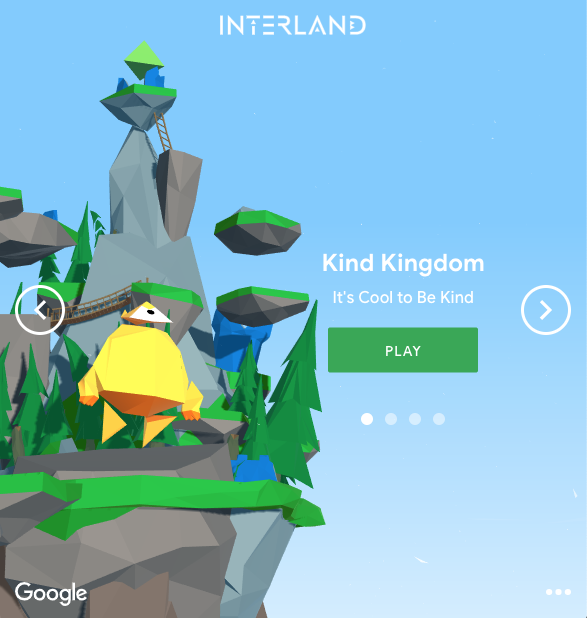
Looking at Google’s Interland

I have picked up this game from Wired magazine’s parenting group and I loved how Google is promoting internet safety by educating kids on how to be safe online.

Teaching kids about kindness through an interactive game is really cool. I also admire the progress of the web nowadays being able to deliver such interactivity on a browser.

You can play Interland here.

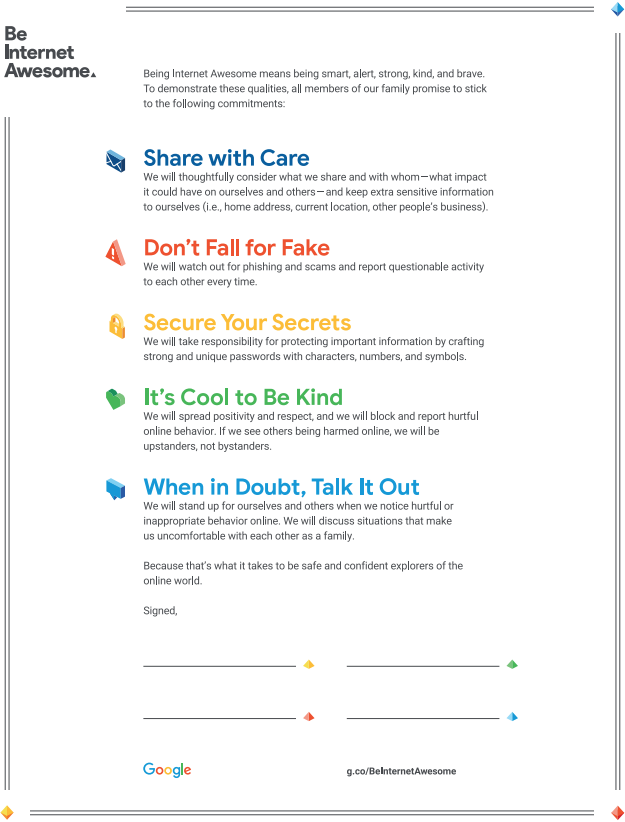
And while you are at it, discover and Be Internet Awesome.

Category: PostIt | LEAVE A COMMENT
May 20 2019

How important is self-care in parenting?

Lately, I’ve been doing things for myself. I’ve been reading, taking long showers, going on walks and sometimes treating myself to a nice lunch. Simple things but it has made a difference.

It has made me a better parent.

As a mom, how can you incorporate self-care in your everyday life to fill your self-love tank?

  • A good example is household chores, while cleaning your home or doing the laundry, listen to your favourite music. 
  • While going out on walks, look around and see the beauty of your neighbourhood. 
  • While cooking food, concentrate on the taste and aroma of what you are cooking. 
  • After a long day at work, spend 3 minutes in your car letting go of all the challenges, tiredness of the day before going in and meeting your family… rub your favourite hand lotion on your hands, think of your favourite relaxing place (beach, mountain) and put your hands close to your face, take several deep breaths and enjoy the silence. Before you get out of the car, place a BIG smile in your face and open your door before greeting your kids and family hi.
Category: PostIt | LEAVE A COMMENT
May 20 2019

Teaching new skills

Ideas to help you encourage behavior you like:

  • Communicating
  • Managing feelings
  • Becoming independent
  • Solving problems

Ideas to help you teach new skills:

  • Set a good example
  • Incidental teaching
  • Ask-say-do
  • Reward charts

Below is my action plan.

Get everything ready to set up a reward chart.

Start using these strategies:

  • set a good example
  • use incidental teaching opportunities

Keep monitoring:

  • How many times my kids come when I call them for the first time.
  • How many times I praise them for positive behavior.

Take care of myself:

  • For myself, I would like to try something that I do not know like tracing or feasibility on building an apartment.
  • For us, I would like to try something new for my wife and I. I will ask her first if she is open to visiting a museum on Friday.

Category: PostIt | LEAVE A COMMENT
May 19 2019

Currently playing Brawl Stars

Brawl stars is an all-out game where people get to do lots of stuff (battle, buy, open chests, etc.). In my opinion, this game rules and I can see why this game is rated 4.8.

You can download here.

Fast-paced multiplayer battles from the makers of Clash of Clans, Clash Royale and Boom Beach.

Battle with friends or solo across a variety of game modes in under three minutes. Unlock and upgrade dozens of Brawlers with powerful super abilities. Purchase and collect unique skins to stand out and show off in the arena. Join or start a band to share tactics and fight together.

Features:
Team up for real-time 3v3 battles against players from across the world
A fast-paced multiplayer battle royale mode made for mobile
Unlock and collect new, powerful Brawlers – each with a signature attack and SUPER ability
New events and game modes daily
Battle solo or co-op
Climb to the top of the leaderboards in global and local rankings
Join or start your own Club with fellow players to share tips and battle together
Customize Brawlers with unlockable skins
Player-designed maps offer challenging new terrain to master

Category: PostIt | LEAVE A COMMENT
May 4 2019

Encouraging behavior that you like

Module 2 of Triple P continues to build on me the practicality of positive parenting. Being on point and zeroing into the goal make it easier by reducing friction and reinforcing positive strategies that are simple to understand and measure.

On giving praise

Think about giving your child more praise. What are two or three things you want to watch out for and encourage?

  • See if they tidy their toys or things and encourage them to maintain it.
  • When my son helps his younger sister and care for her.
  • Being mindful of the positive behavior that the kids do when they eat so it will be a lot easier experience during mealtime.

Make a note of the words you’re going to use.

  • I like that you are helping.
  • It was great seeing you caring for your sister.
  • Seeing that you are able to see your mistake and do it again right the second time around shows that you care a lot about your work.
  • Great eye for details.
  • It’s really good seeing that you care.

Below is my action plan.

Get active

Choose one or two strategies to try out over the next couple of days.

  • spend quality time together
  • praise

Set a clear goal about using the selected strategy (e.g. How many times? When? In what situation?).

  • Twice a week. A minute or two of short but quality time together with me and my wife.
  • Once a day for both kids at home when they exhibited positive behavior.

Set a goal about your own needs or looking after your relationship. What do you plan to do in the next week? 

I would like to continue reading a positive book or rekindle my interest in literature. Having a mindful conversation with my partner is also a priority.

Category: PostIt | LEAVE A COMMENT
April 29 2019

Parenting programs in the Australian context

This is a technical paper with 102 pages but worth the read for parents.

This paper on Early intervention strategies for children and young people 8 to 14 years by Lucy Tully has a list of parenting programs that can be explored to assist in parenting and ensuring your kids will get the appropriate care and support.

If you have been trying to look for parental programs then page 7 of this paper includes the evaluation of three parental programs in Australia namely.

  • Positive Parenting Program (Triple P)
  • Parenting Adolescents: A Creative Experience (PACE)
  • Parenting Between Cultures Program

Quoting the last three paragraphs of the conclusions

Targeted parenting programs have been found to show positive short-term benefits for families with multiple risks, parents with depression, divorced parents and parents of children and young people with externalising problem behaviours. There is evidence that both group and individual programs are effective in improving a range of child, parent and family outcomes. Programs based on a behavioural approach have been found to be effective, although few studies have evaluated programs based on other approaches.

For child-focussed and multi-component programs, the evidence indicated that universal and targeted programs that are skills based were effective in preventing violence, and universal programs that are interactive were effective in preventing substance use. Skills based programs also appeared to be effective in increasing knowledge and skills associated with child sexual abuse, although it is not known whether these programs also impact on behaviour. Multi-component health promotion interventions that target school connectedness were effective in improving a range of outcomes. While there is some support for programs to prevent depression, bullying and drop out, the evidence was mixed. Cognitive behavioural approaches to prevent anxiety appear promising, although further research is needed.

The evidence suggests that interventions that involve home-school collaboration are effective in managing school-related problems. However, there is mixed evidence to support the effectiveness of extracurricular activities, after-school programs and mentoring programs as a strategy for high risk children and young people. There is presently a lack of research on community programs, health promoting schools initiatives and school suspension and expulsion, although one study indicated that suspension may increase antisocial behaviours.

Category: PostIt | LEAVE A COMMENT